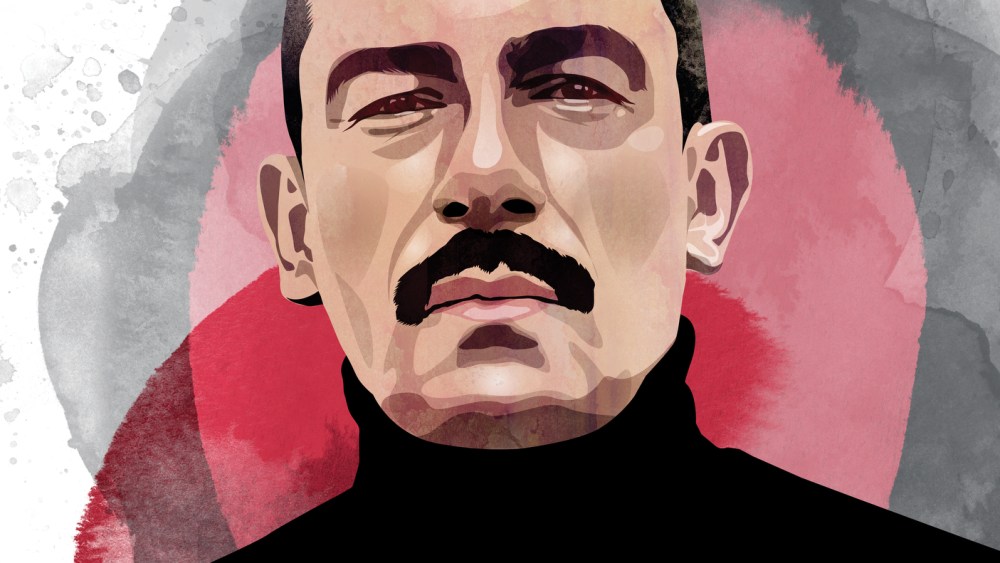
MILAN — A conversation with Haider Ackermann takes you to faraway places and back to fashion, “and a world of dreams,” surprising you with unexpected — and refreshing — remarks. One example: “kindness” is what he looks for as a key quality in a potential new team member. Another is that “silence” is a true luxury for Ackermann.
After all, the designer is quite unique in the industry, forging his own path with bold decisions, even declining high-profile jobs — reportedly Maison Margiela and Dior — because he felt his “own language does not belong there.” Until he got the call “from Mr. Ford himself, and that sets the tone immediately,” said Ackermann, who was named creative director of Tom Ford Fashion in 2024, assuming design leadership across menswear, womenswear, accessories and eyewear.
In the subsequent two years he has garnered acclaim for his impeccably tailored looks in luxurious fabrics, as well as his fluid gowns, sensual eveningwear and arresting color palettes. For this reason, he is the recipient of the WWD 2026 Honor for Womenswear Designer of the Year.
In the nine months ended Sept. 30, revenues for Tom Ford Fashion, a division of Ermenegildo Zegna Group, totaled 226.4 million euros, up 3.5 percent, and in the third quarter, sales rose 5.4 percent to 69.6 million euros, with both retail and wholesale channels contributing positively. At the same time, he has formed a group of acolytes among leading celebrities, ranging from Tilda Swinton to Timothée Chalamet.
Born in Bogotá, Colombia, Ackermann’s aesthetic has been shaped by a unique upbringing, growing up in countries ranging from Ethiopia and Chad to Algeria, The Netherlands, Belgium and France. He studied at the Royal Academy of Fine Arts in Antwerp and launched his namesake fashion label in 2001, which he closed in 2020.
Ackermann relies on a wide-ranging, diversified experience, which includes the role of creative director of Berluti from 2017 to 2018; hosting a one-off runway show with Italian sportswear brand Fila in Manchester, England, in 2022, and in January 2023, designing the Jean Paul Gaultier spring 2023 haute couture collection as that fashion house’s rotating guest designer. He was also named to the creative helm of Canada Goose in 2024.
Here, in his suave and soft-spoken way, Ackermann opens up about his trajectory, fashion, changes in women’s and men’s attitudes and, of course, “Mr. Ford,” as he calls him throughout the interview.
WWD: You traveled so much early on in your life. How has this influenced you?
Haider Ackermann: When you travel so much, there is a sense of freedom that you have, because at the same time you belong to many places, but never entirely to one, so you are free. At the same time, there’s a feeling of loss because you don’t know where you belong, so it’s a very, very interesting contradiction. And when you move so much around at a certain age, and you go from African countries to Holland to Belgium, it’s all very extreme in sense of aesthetics, with all very different cultures, very different backgrounds, very different gestures, the sensitivity of the people. It was interesting at the beginning of my career this melting pot of all those things that I had seen before, all those memories that I have in the back of my mind, because as a designer you can only draw from who you are, and this is my luggage. For people, sometimes that’s not understandable because, of course, when you go from Africa, which is full of color, orgies of gold, and then you come to the austerity of Antwerp, where it’s all black, it goes from one extreme to the other, so it’s been perhaps a little bit of a controlled chaos in my mind, and nowadays I have the feeling that over the years my work has become quieter, and perhaps a sign of maturity, less interested in showing everything and more interested in what remains beneath the surface. I do love the tension and the contrast.

Tom Ford spring 2027
Giovanni Giannoni/WWD
WWD: You have been brave in your career to also say no to major brands that approached you. You have expressed your admiration for Tom Ford the designer, but why did you think the brand was a good fit for you? What was your reaction when you were offered the job?
H.A.: It’s your intuition that speaks; it can’t be explained, it’s instinctive. You feel something, even though you don’t know exactly what it is. I’ve always thought that one has to be very careful with the things that you say yes to, you can jump on many occasions, but you also have to be very faithful to yourself and also understand what you can bring to the house, to the DNA of the house. You might admire the house, but you know that your own language doesn’t belong there, you can’t add something to the vocabulary, so you just want to be very truthful and faithful to yourself and also to the invitation that you receive. It’s very, very important. And I have declined opportunities because, despite their appeal, I could not find a genuine connection with them, and that is really important. With Mr. Ford, it was something totally different because, first of all, the call came from Mr. Ford himself. That sets the tone immediately, and already there’s an immense form of respect that you have for the person who calls you. It’s not only about what he created over the years, but also his vision. He understood that fashion could be much more than only clothes. It could be an attitude and a world and a way of looking at life, whether his movies or architecture, the house that he’s been living in, it’s a whole world of aesthetic that you need to understand. And that’s what fascinated me, because due to that, I felt that there was room for conversation, rather than any kind of repetition that I could eventually do. That was important to me, and I had a feeling that somewhere I could contribute something to it, because also during the conversation that we had already, my mind was traveling, knowing what I would do on the show, even the first look.
WWD: Did you know him personally?
H.A.: We had met each other very briefly, but we knew each other’s work, obviously. But we also knew that we respected each other’s work very much. He had mentioned me several times to the press, and he also had the kindness to write me beautiful letters when I started at Berluti.
WWD: You have said before that you are not attempting to imitate Tom Ford and his aesthetic, so how would you define your take on the brand, and what kind of responsibility is it, working under someone else’s name, and someone like Tom Ford?
H.A.: When a house calls you, you should never forget that you are at the service of that house, and that’s something one can never forget. There is responsibility in that, and I take it very seriously. It is not my house. I’m at the service of someone else, and I find it gives you also a sense of freedom in that sense, because you feel less restrained, you put yourself in the imagination of the other, it’s like playing a role. Perhaps when it’s your own name, you are much more anxious, you are more nervous. It’s very interesting because people would think that you would feel more free with your own brand, but no, there there’s so much more questioning. Not that I don’t question myself here. Don’t get me wrong, but it feels like much more like a beautiful gesture that you can do. You receive this gift, and it’s up to you to honor it. And in my approach, I listen to the house and ask myself, what does it need and what can I bring that is honest with my own sensibility and that will remain faithful to the spirit of the house. I’m perhaps drawn to a much more discreet kind of seduction than Mr. Ford himself was. Perhaps I don’t like when things are immediately revealed. There’s sensuality in the gestures, in the tension between the strength of Mr. Ford and something almost very fragile, which might be more my side. The responsibility is to make sure that the house continues to have a voice and that it remains relevant and desirable and that it doesn’t lose its soul, so that’s a big task.

Tom Ford spring 2027
Giovanni Giannoni/WWD
WWD: What do you think you are bringing to the house of Tom Ford to maintain this relevance and desirability?
H.A.: What I’m trying to do is to have a dialogue with the house and Mr. Ford, to open up this conversation and to see where it leads. I don’t know at this very minute exactly what I’m adding. Also, the thing is we live in very different times, we have to learn to deal with them, times change and the will of the woman has changed. Before, perhaps the seduction of the woman was the power in the big shoulder pads, and maybe now the power of a woman leans more into her own voice, and she will dictate whether she’s ready to do something or not.
WWD: And what about the men? For spring you pushed boundaries, sending on the runway a male model in a crewneck sweater and a pale pink thong.
H.A.: That is also very interesting because the vanity of men is very different from before. I have the feeling men nowadays are more vain than they have ever been. They are much more generally playful. They embrace their femininity more. What you see nowadays on the red carpet for men is sometimes, even though I played a part in it, it’s sometimes a bit frightening because it becomes too much. So perhaps I’m attracted to the world of Mr. Ford to respect the elegance of a man in the most classical way, and that’s something that I embrace very much nowadays.
WWD: On the topic of fashion shows, how do you approach them? Do you have a theme that maybe you want to project? Do you think of the location when you’re thinking about the collection? Do you think about the music? Just in general, what is your modus operandi when you are conceiving fashion shows?
H.A.: You have a story to tell, and you have the luxury for 10, 12 minutes to try to keep the noise outside, to try for people to forget about their worries, their problems, their lives. If we have the capacity to make you for those 10 minutes absorb this moment, which is often with me quite cinematographic, then you can see those beautiful, handsome girls and boys passing in front of you, and you forget about yourself, then I think we succeeded with the show, and that’s what my goal is.
WWD: Do you feel pressured in your work? And if you do, how do you cope with it? As you said, the world has changed a lot and there’s always a lot of attention on creative designers, a lot of changes, and you work for a big brand. Do you listen to the voices outside? If so, how do you react?
H.A.: I listen to my own voice, and that’s already putting a lot of pressure. Trust me on this one, and I put on myself that much pressure because it’s something that I generally really care about. It would be very worrying if I wouldn’t. It’s a big responsibility. You are responsible for the team, for the [Ford] name, for the expectations of people, for the clients who’ve followed the house for many years, so you cannot take that lightly. I don’t think it’s the outside world putting pressure on me, I think it’s myself. But I’ve learned also that pressure becomes quite dangerous when you allow it, and you allow it to take it away from yourself. One should not make decisions because you’re afraid of disappointing someone, or because you need to prove something. Perhaps also this invitation came now that I’m much more mature. So I don’t have the feeling that I need to prove something to anyone. I just have to continue this language that Mr. Ford started and give it another tone. That’s what my responsibility is. That’s how I feel.
WWD: Scrolling through your Instagram handle, you post from your trips around the world, you seem to be very much into nature, also a link with your post at Canada Goose. Does nature help you unwind?
H.A.: Nature is essential, it’s all about breathing, and to lose yourself in nature and to feel yourself so small against this majestic countryside and landscape, to take the time to stay away from the noise. It is very rewarding because you come much clearer out of it. Silence is kind of a luxury, and taking the time is a luxury. These are my luxuries.
WWD: In addition to the WWD Honor, you have received several accolades during your career, for example the Fashion Group International Award for Design in October 2012, presented to you by Karl Lagerfeld, so how do you feel about these kinds of prizes?
H.A.: That’s a beautiful question, but a very complicated one. Of course, needless to say, I feel very grateful. It’s always touching when people recognize your work, particularly in an industry where everyone is working so hard, and there’s so much talent. Also, I think that nowadays we go into such a beautiful period, where all the houses are really trying to be innovative and it’s very interesting. But I do have a slightly complicated relationship with recognition, of course, because you never really know how to measure what you do. Passion is very subjective, and that is one of the beautiful things about it. An award is not something that changes the reason why you wake up in the morning. You still have to work, go to the studio, look at the clothes, question yourself, and start again. But what makes it very meaningful is to also recognize the people around me. I have a team with me. A collection is never the work of one person alone. It’s a result of many hands and many conversations and an enormous amount of trust, so I see this award more for them than for me, but I receive it with lots of gratitude, of course. And tomorrow we continue working. It’s another day.
WWD: What is your view of the fashion industry today?
H.A.: I do love my industry, 20 years ago or today. Things are moving forward, changing. I remember when I started, I went to see the first show of Mr. [John] Galliano in the [fall 1994-95 hosted by Parisian art patron and socialite] Maria São Schlumberger. Things have changed differently, but for me personally, it’s still for me realizing the dreams in a world of dreams: of course, very much anchored in reality because it’s a business. But you never forget that a collection starts from one person’s dream, and from then on, everything moves on. And that’s something that sometimes I have a feeling the industry forgets a little bit. It’s the dream of one person, who stays awake quite a few nights to just try to figure it all out. So, I do believe in our industry, I do believe in our dreams, and in beauty, which is more needed than ever before, due to all the violence and aggression out there.
WWD: Is there anyone you consider a mentor?
H.A.: I did not have a mentor. I did not know that fashion existed growing up in Africa, so I was very far away from all of this. But I was surrounded by men and women wrapped in fabrics. I knew that I was always curious to reveal the mystery behind the movement of fabrics. When you grow up in foreign countries, you don’t necessarily always speak the language. You become this very isolated person who is the observer because that’s what you are, and you build up stories in your head, and I built up many, many stories in my head. I just looked at what was around me, and that was quite remarkable. It’s true that one day I met [legendary French perfumer] Mr. Serge Lutens and at some point in my life I wanted to quit everything and just to be by his side for one year because I’ve never heard any person in my life talking that graciously and beautifully about what beauty was or the definition of beauty, and if I could have, I would have stopped everything for a year and just listened to him. In French you say, “Ma plus belle rencontre [My most beautiful meeting].” It’s been the most extraordinary meeting I have had, and we built a friendship over the years.
WWD: You mentioned your team earlier, what do you look for in an associate?
H.A.: Perhaps something that is not related to fashion at all: kindness.
We need that, and I do believe that when you surround yourself by kind people, you can achieve many things. Perhaps it’s not the easiest way, the most hardcore or the most ambitious one, but it’s the most beautiful in the long term, and in this I truly believe.

The new Tom Ford Fashion store in South Coast Plaza.
courtesy image
WWD: In November 2022, the Estée Lauder Cos. Inc. said it was acquiring the Tom Ford brand in a transaction valuing the company at $2.8 billion. As part of the deal, the Zegna Group and Marcolin entered long-term licensing agreements for Tom Ford fashion and Tom Ford eyewear, respectively. Can you tell us about working with such major groups?
H.A.: I am so grateful to work for these three companies. Obviously given the nature of my job, I am in close contact with Mr. [Gildo] Zegna [chairman of the Ermenegildo Zegna Group], who has a profound understanding of craftsmanship,of the making of garments, and the importance of building something that lasts. I have an immense respect for him and I do believe him also to be a very kind man. I don’t know if he’s going to like me saying that, but there’s something very genuine about him. I do care a lot about the integrity of garments and the details, and it’s something that’s very meaningful to me, and it’s something that he can relate to, that he can understand. As for Marcolin, it’s a new language for me and it makes my heart beat faster because it’s something else that I’m learning. Of course, eyewear is so important for the Tom Ford universe, it has the ability to define a face, an attitude, even a personality, and I think that makes it very powerful for the expression of the brand.
WWD: Are you thinking of additional brand extensions?
H.A.: I think at some point jewelry should grow into the world of Mr. Ford, which is very big. I secretly imagine about houses, furniture, it can go very far because it is not, as I said before in the interview, Mr. Ford, it’s an entire world. It’s not just about the clothes, it’s about the whole attitude, the whole mood, the whole surrounding. It’s not surprising that he went into the movies because, when you look at my show, the clothes are a little bit part of the whole story. I always know the music in advance. I always know the hair and the makeup before I even start the clothes, so the clothes are just a part of the story I want to tell in basically, and I think that’s what Mr. Ford was about as well. In that sense, we really understand each other absolutely.
WWD: Do you have a dream you would really like to see turned into reality?
H.A.: I have plenty of them. I still have a long, long road to go, and I do believe, strangely, awkwardly, that my best years are still to come. So, yes, allow me to dream, but don’t ask me to reveal them [smiling].