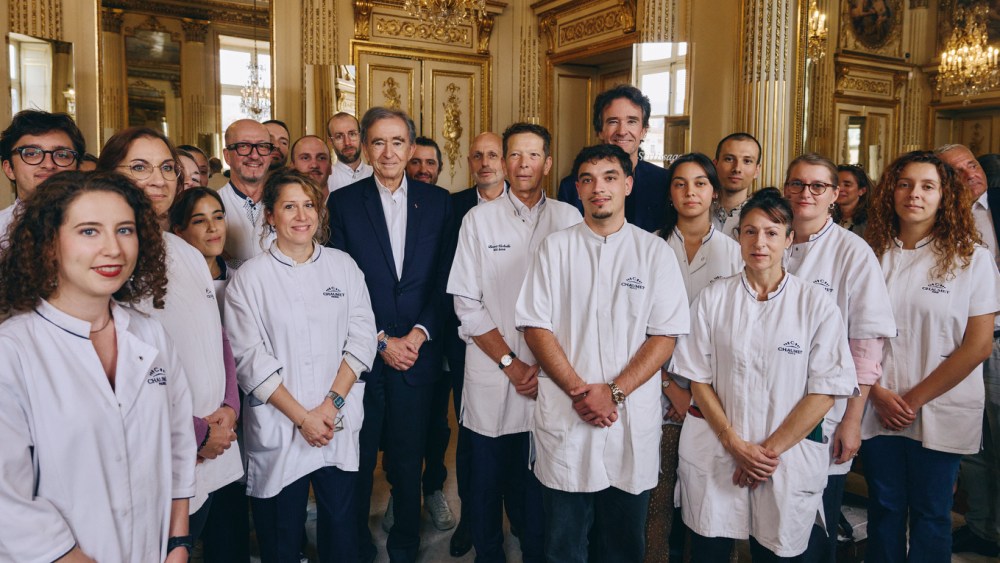
As the longtime chairman and chief executive officer of LVMH Moët Hennessy Louis Vuitton, Bernard Arnault is one of the most visible and scrutinized executives in the consumer products industry.
Still, he has the ability to surprise — and amuse. In an interview with WWD on the occasion of receiving the 2026 John B. Fairchild Honor for Lifetime Achievement, the business titan described the simple pleasures of going to the office every day, his hidden talents as a visual merchandiser and that one personal investment he walked away from too soon.
But mostly he described his passion for the craftsmanship, creativity and excellence at the root of LVMH’s various maisons, which include the likes of Louis Vuitton, Dior, Celine, Fendi, Bulgari, Loro Piana, Veuve Clicquot, Guerlain, Chaumet, Hublot and more.
WWD: You studied civil engineering. How did this education prepare you well for your business career?
Bernard Arnault: I entered École Polytechnique in 1969 and graduated in 1971. Unlike my classmates, I did not want to pursue a career in the French administration; I knew I wanted to support my father in running our family business. So, right after graduating, I went back to Roubaix, my hometown, to work alongside him. That was a turning point for me, and I tried to bring fresh ideas to help the company grow.
What my education at Polytechnique, a scientific school, gave me above all was rigor and the ability to simplify complex problems. I was fortunate to have a professor like Laurent Schwartz, a Fields medalist, whose clarity left its mark on me. In an artisanal maison, that rigor is what allows you to respect the artisan’s time and the craft’s exact standards, without ever losing sight of the long-term structure of the business: building something that must still stand, still be excellent and still be desired, decades or centuries from now.
WWD: You’ve always taken a long-term view on business and brand-building. Where does this conviction come from, and why is a long-term view necessary?
B.A.: This conviction comes first from my family: my father and grandfather ran Ferret-Savinel in Roubaix, and that is where I learned the value of patience, effort and building something meant to last beyond yourself. In our maisons, long-term success is about the product, and a product of very high quality cannot be rushed. It requires time, patience, sometimes remaking the work until it is right. That is the nature of craftsmanship.
Our maisons, taken together, carry more than 5,000 years of combined history, savoir-faire and artistic tradition. You cannot run heritage like that with a quarterly mindset. You run it the way a family runs its own home: thinking in generations, not in quarters.
WWD: I’ve witnessed your enthusiasm in the presence of creative figures like Peter Marino, Frank Gehry, Karl Lagerfeld and Nicolas Ghesquière. Where did this passion for creativity come from?
B.A.: I think my passion for creativity started very young, when my parents and grandparents took me to museums, galleries and all those places where art is written with a capital “A.” What I understood there is that creativity is not a mere feature, it is a real talent, and today it stands as one of LVMH’s core values.
What I have seen and witnessed, time and again, with the extraordinary creative figures I have had the privilege to work with, is this: They take a blank page and invent something that did not exist before. That is the real act of creation.
In this respect, LVMH is truly unique: We attract the best talents, and we let their creativity explode without constraints. We give them the freedom to imagine, to take risks, to go further than they thought possible, but always within the respect of the maison, its history, its savoir-faire, its codes. That balance is rare: total creative freedom, combined with total respect for the craft and the heritage that came before. It is precisely that combination that allows a maison with centuries of history to keep reinventing itself, season after season, without ever losing what makes it unique.
Without that creative force, quality and heritage alone are not enough to build and sustain the future of a global maison.
WWD: Putting modesty aside, what are your proudest achievements over your long career? And where do you find your greatest satisfaction in business?
B.A.: My greatest pride is having built, I believe for the first time, a French, family-run global leader: the largest of its kind in the world, and one that still has a great deal of potential ahead of it.
We started from a small family company in Roubaix, in real estate, and managed to become a world leader in high-quality, artisanal products made in France, Italy, the United States and more, renowned the world over.
What gives me satisfaction every day is simpler: the passion I bring to what I do. I enjoy coming to my office every day — and visiting with employees at boutiques on the weekend — and that passion for creativity and excellence is what allows me to work a great deal, for a long time, without it ever feeling like a burden. It is also, I think, what lets you keep a long-term, family-minded commitment to the business, rather than a short-term one.
WWD: What are some of the most important management lessons you’ve learned: on the job, from your most important mentors and perhaps from challenges or mistakes?
B.A.: In our business, it is the quality of the product and the craftsmanship behind it that seduce the client. I try to run a large group like a start-up and avoid unnecessary complexity, bureaucracy and reporting, which slow down execution and dilute a sense of responsibility. The idea matters, but anyone can have an idea; what matters most is the execution of that idea.
For decades, I’ve had people around me, very talented people in many fields, who gave me advice and told me I should do things this way or that. I listened to that and trusted my instinct, chose to pursue what I thought was the best idea, even when the context was not always favorable. And here we are.
You must also remain permanently dissatisfied, question yourself constantly, seek out and listen to contradictory views rather than assume you are always right.
My first mentors were my grandfather and my father. My grandfather took me to construction sites from the age of 5 or 6. Both of them passed on to me a sense of effort, duty and loyalty, values you find again in any true artisan. My father advised me, when I joined the family business, not to change things too quickly, but to first understand how they worked, and to trust the teams and the know-how already in place. Antoine Bernheim, one of my early advisers, used to say that the secret of business is being in the right place at the right time.
As for mistakes: I made one with my personal investments. I sold my Netflix stake too early; it has since multiplied tenfold! It’s a wonderful company.
WWD: LVMH always ranks very highly among the most desirable employers in Europe, and the fashion/luxury sector has become more attractive to new generations. Why do you think it has such a pull?
B.A.: LVMH is not a faceless company with a distant board; it is a family company, and I want everyone who joins to feel like part of that family. We advance through merit, but we also carry forward something larger than any one career: maisons whose combined [years offer] a rich history of savoir-faire.
Young people today want more than a job. They want to belong to something built to last, something with meaning and craft behind it, managed with the patience of a family rather than under the pressure of a quarterly report. I think that long-term, family-run character, combined with genuine meritocracy and the speed of a start-up, is exactly what draws new generations in.
WWD: I’ve noticed, especially recently, that you rarely use the word luxury. Why is that?
B.A.: I don’t particularly like that word. It is too often associated, pejoratively, with frivolity, superficiality, uselessness, with “bling-bling.” That is not what we do. We are artisanal and creative maisons, producing very high-quality products in limited quantities, each carrying real savoir-faire. It is not an industry in the classic sense; it is a constellation of artisans and creators, families and houses, some of them centuries old.
Our long-term success rests on the product, on heritage, on craftsmanship and on a demand for refinement, the exact opposite of what the word “luxury” may often suggest. And you can see this in the success of Les Journées Particulières, which we just held in 13 countries worldwide. There is no luxury in that event, but there is meaning, passion, sharing and people. That’s what people look for, especially nowadays.
WWD: I understand you still visit stores every weekend, and most of your children started their careers at LVMH on the shop floor. Why is it so important to be on the sales floor, and how do you get the most out of these visits?
B.A.: This is a habit I picked up in my childhood, when I visited our construction sites with my grandfather. Later, at LVMH, it became a tradition as well, visiting our stores together with my children.
The shop floor is where the craft meets the customer, where you see whether the quality and the savoir-faire behind a product are truly being honored and understood. And you don’t feel that from behind an Excel spreadsheet at a desk.
I also travel a lot to meet our people, see them in our ateliers and stores. There, I pay meticulous attention to the smallest details at a point of sale. Some store managers joke that I should be hired as director of visual merchandising, after the changes I have regularly suggested in our stores.