LONDON — Creative heads are rolling at Kering, and the latest is Pierpaolo Piccioli, who is exiting Balenciaga after less than 18 months having designed just four collections, including his couture debut last July.
Piccioli’s exit had been widely tipped following mixed reviews for his collections. The Italian designer follows McQueen’s Seán McGirr and Saint Laurent’s Anthony Vaccarello out the door amid sluggish sales at the group, which is undergoing a restructuring under Kering’s chief executive officer Luca de Meo.
The designers’ successors haven’t been named yet, although Kering said Balenciaga’s new creative chief would be revealed shortly.
Gianfranco Gianangeli, president and CEO of Balenciaga, said Thursday that Kering was “deeply grateful” for Piccioli’s contribution to the brand. “Through his vision, he reaffirmed the couture origins of the house, bringing his considered approach to craftsmanship, construction and creativity. I would like to sincerely thank him for his dedication, generosity and collaboration.”
De Meo described Piccioli as “an exceptional couturier and creative talent for whom we have the greatest respect. Our ambition is to build on Balenciaga’s avant-garde spirit, honor its remarkable heritage and continue to push creative boundaries, further establishing the house as a powerful and relevant voice.”
Piccioli spent much of his career at Valentino, earning rave reviews for his solo designs and the ones he made alongside his former creative partner Maria Grazia Chiuri, now creative director of Fendi.
While his handful of collections for Balenciaga featured some beautiful pieces, it quickly became clear he was not the man for the job.
It is understood that Kering wants to take Balenciaga back to its edgier, and less romantic, Demna days. Demna, now creative chief at the Kering-owned Gucci, designed Balenciaga for nearly 10 years, turning out sharp-edged, street-wise collections and courting controversy with his ad campaigns.
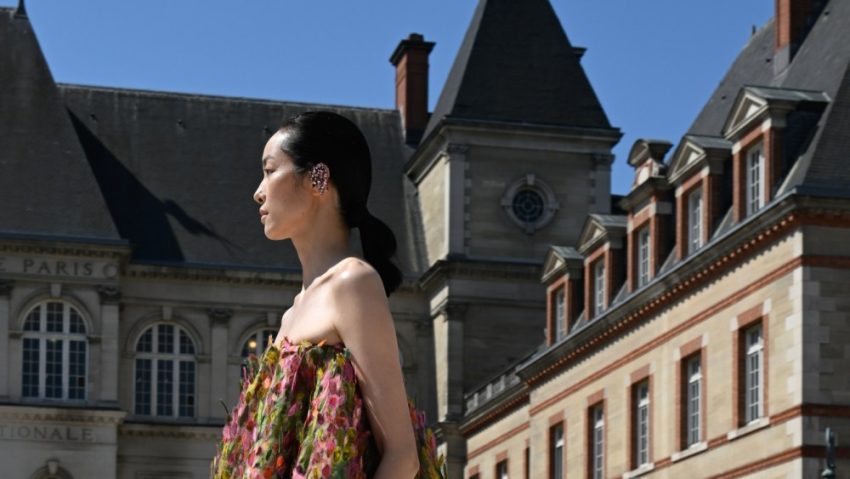
A seasoned and accomplished couturier, Piccioli made his high-fashion debut at Balenciaga in July, one year after arriving at the French house after his long, glorious career at Valentino in Rome.

Pierpaolo Piccioli
Casper Kofi/Courtesy of Balenciaga
“I really get that idea of Cristóbal Balenciaga: that a couturier has to be a sculptor, or architect for the shapes, has to be a painter for the colors, a philosopher for how people feel in your clothes. All of this is something that I can take inspiration from,” he told WWD earlier this year.
“But in a way, it also has to be very personal; I’ve learned to react in a very instinctive way,” Piccioli said, adding that couture also needs to be “related to the moment … and related to life.”
As reported, de Meo is banking on creative director renewal to rev up demand in a cold climate for soft luxury. But it’s clear that investors are worried that all the creative churn will prove more of a challenge than an opportunity.
Kering released its third-quarter results last month. They showed that Demna’s fresh take on Gucci, the group’s star brand and main profit engine, struggled to gain speed amid a sector-wide slump in demand in China.
The French luxury group said revenues for the three months ended Sept. 30 remained flat at reported exchange rates, totaling 3.35 billion euros. This represented a decrease of 1 percent in comparable terms, above a consensus forecast for a 1.3 percent organic sales drop.
Gucci missed expectations, posting a 6 percent drop in sales at constant exchange rates, worse than the 5.4 percent decrease expected by analysts.
During a call with analysts, management argued that the creative shake-up would eventually bear fruit.
“Each brand is on a specific trajectory, and each situation is very different,” said chief financial officer Armelle Poulou.
She emphasized that Kering was putting in place a “more efficient operating model” around designers to ensure their vision is backed up by the product development, marketing and merchandising teams.
In an exclusive interview with WWD last month, de Meo said his ambition was to “re-engineer” the creative process.
“A creative director for me is like a captain, the playmaker of a team. He’s the one that has more talent, that kind of technical ability to solve the game in an unexpected way,” the former Renault Group boss said.
“But without a [support] system around, I believe that we cannot run multibillion, multicategory, multi-geography businesses and ask them to do everything from store layout to marketing.
“So I will try to change the way the studio interacts with the rest of the organization in the spirit of finding a more collaborative way of handling the complexity,” he said.