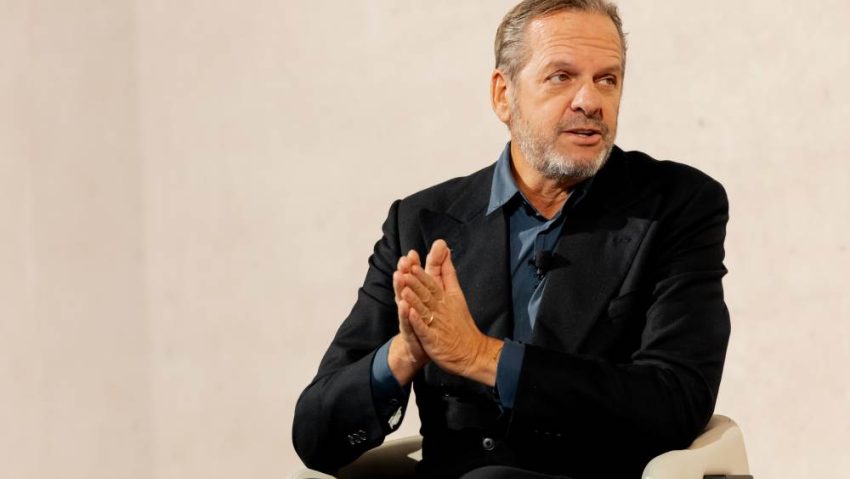
Speaking at WWD’s Apparel and Retail CEO Summit last week, Marco Balich didn’t seem to think he had much to offer the audience. “I don’t know if I can be very helpful for CEOs in luxury,” he humbly admitted at the start of Tuesday’s conversation with WWD’s Milan bureau chief Luisa Zargani.
But as luxury brands continue to offset a downturn in aspirational spending by engaging their VICs IRL, the Balich Wonder Studio chairman and creative director’s insights are, in fact, very helpful.
As Zargani laid out, his Milan-based live-entertainment group has produced ceremonies for 17 Olympic Games and six FIFA World Cups in addition to several Alta Moda shows for Dolce & Gabbana, including the latest multiday spectacle in Taormina.

Marco Balich and Luisa Zargani at the 2026 WWD Apparel and Retail CEO Summit.
Courtesy of Allie Joseph
Perhaps Balich didn’t think he had much to offer because he views the fashion industry like one of the millions of people who watch his sports ceremonies: as a spectator. He’s always admired the “filter of beauty” that fashion applies to all of its expressions, he said, be it physical merchandise, retail or the runway. “I’m fascinated by that.”
That fascination is what led him to expand in 2013 with Balich Bespoke, an offshoot of Balich Wonder Studio tailor-made for live event production for the world’s leading names in high fashion and jewelry. Alongside Dolce & Gabbana, Bespoke clients include Bulgari, Max Mara and Louis Vuitton.
According to Balich, fashion shouldn’t be treated as a niche interest shared by a select few. “It’s crucial that everything we do is understood by a 14-year-old distracted guy, whether in Kamchatka or in Chile,” he said, adding that the best way to accomplish that is through emotion. Otherwise, a pretty dress or gold trophy is meaningless without feelings of “unity, love, respect and beauty” to charge them.
Calling out fashion for its “snobbish approach” to events, Balich said all it takes is a “little flick” of meaning to fuel desire and establish a direct connection with everyone on the other side of the velvet rope. “I mean, those big brands are huge, so it’s really important that they add that flick.”
Asked how much of a role location plays in that “flick,” Balich responded: “I don’t think location or budget are essential…OK,” he allowed, “the more budget you have, of course, the happier we are. But at the end of the day, [the goal] is to be meaningful.”
As an example, Balich recounted the opening ceremony of the Milano Cortina Winter Olympics produced by Balich Wonder Studio. He said his challenge was celebrating Made in Italy craftsmanship in a way that wasn’t so obvious as to come across as a marketing ploy.

Models wearing suits designed by Giorgio Armani during the opening ceremony of the 2026 Milano Cortina Winter Olympics.
Courtesy of Getty Images
Screens at the summit projected a video of 60 models dressed in green, white and red pantsuits by Giorgio Armani. Balich described the late fashion icon as a symbol of Milan and an “exceptional story” of a self-made man who rose to become a global powerhouse. “So we took him, which, as you know, he just passed away, and we celebrated him through…something that was very meaningful for the people there at the stadium and the people in Italy, at least, which was the celebration of the Italian flag.”
The suits were some of Armani’s last creations, “so it was a celebration of the outfit, but within a context that was meaningful,” Balich said. “It still gives me goosebumps.”
Pressed to suggest more ways that fashion can find meaning, Balich put up another humble front, saying: “I don’t know if I can,” before discussing the value of simplicity.
Oftentimes the belief in any creative industry is that a complicated message translates to cultural panache, but “I’m totally against that principle. Simplicity can be super cool,” he contended. “Simplicity can be understood by everyone. And that doesn’t mean that it’s banal or cheap. It can be a beautiful statement, and that is something in this new world dominated by social media that I think is very important to adopt.”
Another lesson Balich has for fashion? Put down the AI assistants. “If you give a brief to Claude, ChatGPT or Gemini, and you say, ‘Do this ceremony with these kinds of features that has to celebrate fashion design or whatever,’ it will come out with the same answer.” But if you give the same prompt to three different creative directors, he explained, that brief will come out with three totally different points-of-view. And “points-of-view are what make our world more interesting, the luxury world, fashion shows more interesting.”

The opening ceremony of the 2026 FIFA World Cup at Mexico City Stadium.
Courtesy of Getty Images
A second video then played, showing this summer’s FIFA World Cup ceremonies in Canada, Mexico and the U.S., proof that three POVs are greater than the sum of their parts.
Translating the idea to fashion, Balich put it like this: “If only the beautiful fashionista can get my products, it’s an excuse not to challenge yourself with a wider audience, so when you do your shows, be courageous.”
He acknowledged efforts to make the runway more accessible like livestreaming, watch parties and public venues, saying these can turn something that’s traditionally business-to-business into entertainment for consumers. “I think that’s a very clever way to enlarge.”