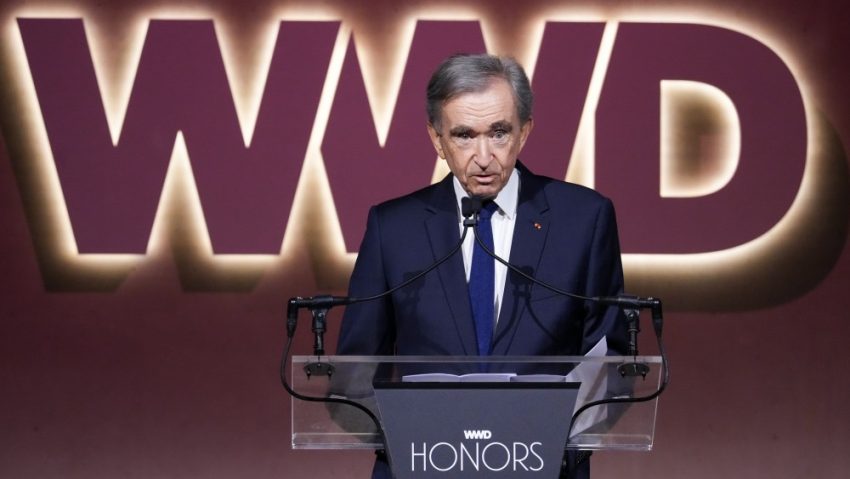
Bernard Arnault and New York City go back a long way, engendering what he described as a “special connection.”
“My elder children grew up nearby, in New Rochelle, and my younger ones feel at home here,” he told an audience of 450 after receiving the John B. Fairchild Honor for lifetime achievement from WWD at the WWD Apparel and Retail CEO Summit in New York. “I admire New York’s energy and determination to move forward. Here, every minute counts. There is even an expression for it: the ‘New York minute.’
“Charles Lewis Tiffany understood this better than anyone, turning each minute into ‘60 seconds of pure possibility.’”
In an 11-minute acceptance speech laced with humility and dry humor, the chairman and chief executive officer of LVMH Moët Hennessy Louis Vuitton shared his admiration for creativity and his flair for business success, occasionally mentioning beloved brands in the vast LVMH stable.
For example, he lauded Charles Lewis Tiffany, founder of Tiffany & Co., for revolutionizing the world of jewelry.
“He brought together European legacy and American innovation to create something unique. He introduced new ways of selling with the legendary ‘Blue Book,’” Arnault related. “He set new standards of excellence that have endured over a century. He had a vision. He was a true American entrepreneur.”
Arnault, who acquired Tiffany & Co. in 2021, also exalted his long ties to WWD and its legendary — and feared — publisher and editor John B. Fairchild, whose grandfather founded WWD parent Fairchild Publications in 1892.
“Back in 1991, at a ceremony a few blocks from here, John Fairchild said about me that I was ‘almost American.’ I almost took it as a compliment,” the French business titan said. “America also taught me a lesson about perspective. In Paris, when we look at a building, we ask: ‘How old is it?’ In New York, you ask: ‘How much is it?’
“I must admit that, over the years, I have learned to ask both questions,” he said, chuckling along with the audience.
He described Fairchild as an early “enfant terrible of fashion.”
“He turned a rather small family newspaper business into one of the most feared institutions in fashion. John could turn a designer into a star or make them disappear from the pages of his newspaper for years — if not decades,” Arnault told the rapt audience, dappled with celebrities including Adrien Brody, Tracee Ellis Ross, Aaron Taylor-Johnson and Michelle Monaghan. “If the story was about you, you hated it… If it was about somebody else, you enjoyed it.
“Under his leadership, Women’s Wear Daily became WWD, three letters that pack a big punch. And believe me, nobody wanted to be Mr. Fairchild’s punching bag,” he continued amid more knowing chuckles from the industry-heavy crowd. “John understood before anyone else that fashion was not just about clothes. It was about people: Designers, models, clients, artisans, entrepreneurs.”
According to Arnault, Fairchild’s WWD “told the story of fashion as a battlefield.”
“For an industry devoted to making beautiful things, we have developed a remarkable affection for the language of war,” he remarked. “The media talk about our brands launching charm offensives. Even the customers can become victims… Fashion Victims, of course, an expression that Mr. Fairchild helped make famous.” (Or, in his oft-used abbreviation, FVs.)
Arnault also gave a shoutout to Edith Rosenbaum Russell, who became the first Paris correspondent of WWD in 1908.
“She was quite a character, regularly crossing the Atlantic by ship, with beautiful trunks… probably Louis Vuitton ones,” Arnault said with a little smirk. “She became famous for surviving the sinking of the Titanic in 1912 while making sure to claim a very big insurance file for the luggage she lost.”
Famous for his long-term vision and ease with risk and business turbulence, Arnault reminded the audience that fashion has never been an easy sector.
“For as long as I can remember, I have heard people talk about the ‘crisis of luxury,’” he said. “In the 1950s, long before AI and robots, designers were already fighting against machines — the sewing machines.
“Then came the oil crises and the financial crises,” he continued. “Shortly after I took over LVMH [in 1989], I was told that the great decade of luxury was already behind me. Then came the dot-com crash, the subprime crisis, and the pandemic. Each generation has rightful reasons to worry about the future. But, somehow, each generation finds new ways forward.
“The future does not belong to those who comment on crises,” he argued. “It belongs to those who adapt to them and continue to create what women and men will love for decades to come. That is what I will keep working for.”

Hélène Mercier-Arnault, Bernard Arnault and Michael Rider.
Kristina Bumphrey
Still, Arnault was upfront about his sometimes controversial reputation, noting that his history of hostile takeovers and a relentless acquisition spree has earned such nicknames as Terminator, Wolf in Cashmere, and King of Luxury, though he prefers the term “high-quality products” over “luxury” to describe the core activity of LVMH.
He was not comfortable with the moniker Emperor of Fashion either.
“As you know, in France, our kings have not always ended well. And our emperors have not done much better. So I have learned to be rather cautious about these titles,” he demurred. “There is, however, one name I believe I have escaped so far. It is Dictator.”
Legendary French designer Christian Dior was not so lucky, though he landed on the cover of Time magazine in March 1957 with that word in a headline thanks to his iron grip on trends in the midcentury period.
According to Arnault, Dior conquered the fashion world “through his creative genius, his vision, and his taste for revolution. A very French quality, I should add,” he said wryly in one of several veiled references to the violent protests that erupted in many cities in France in recent weeks.
“His New Look was so disruptive that he was initially greeted in America by protesters holding signs reading ‘Dior Go Home,’” Arnault recounted. “The genius of Dior was not to design clothes that women liked at the moment. It was to design clothes that women would love over time. A collection may last a season. But a true maison could last centuries.”
Arnault exalted the role American women have played in fanning the success of French fashions.
“For more than a century, American women come to Paris in search of that little je ne sais quoi,” he said. “French savoir-faire and sense of elegance have a long history, going back to Louis XIV and Versailles, and even further.
“The great history of Paris couture would not have been the same without American women,” Arnault contended. “They were truly the first Very Important Clients or VICs, and, long before social media, the first influencers. From New York society to Hollywood, they brought French fashion into American life, and then to the rest of the world.”
Arnault has certainly done his part to further propel the stature of French fashion and leather goods in the world by conscripting such powerful designers as Karl Lagerfeld, John Galliano, Marc Jacobs and Virgil Abloh to rev up the likes of Fendi, Dior and Louis Vuitton.
“Together, at LVMH, we made bold decisions. We embraced the future despite the challenges of the present,” he said.
Arnault said he shared his WWD Honor “with everyone contributing to the future of our industry.”
“We have been fortunate to work in the footprints of some giants. Christian Dior was one. John Fairchild was another, in journalism. And Hubert de Givenchy, at six-foot-seven, was certainly a giant in every sense of the word,” Arnault said. “And speaking of giants, I think of Atlas, holding the famous Tiffany clock on Fifth Avenue. For more than 170 years, he has carried the weight of time on his shoulders.
“The engineer in me would like to conclude by quoting someone who had a huge impact on our lives, even though he was not a fashion designer,” Arnault continued. “Isaac Newton, the father of modern physics, once said, as you probably recall: ‘If I have seen further, it is by standing on the shoulders of giants.’
“We are all standing on the shoulders of giants,” Arnault said.
James Fallon, chief content officer of WWD and Fairchild Media Group, presented the award to Arnault, lauding him for “revolutionizing the quiet world of French luxury with a more professional management approach, a willingness to take risks, and in his words, persistence.”
Fallon related how Mr. Fairchild spent most of his time in the company of creative types, preferring them over dry businessmen.
But he “admired and respected Bernard Arnault, who can discuss the Études of Chopin or the works of Gerhard Richter as easily as he can a balance sheet.
“In essence, he is a Renaissance man, and there are very few of those around,” Fallon said. “In any interview or conversation, Bernard Arnault emphasizes passion, loyalty, and hard work. But above all, his focus is on the creative aspects of the maisons that make up LVMH. In one of my favorite quotes, that I believe should be a sign on every CEO’s desk in the world, he once said, ‘If you fuel creativity, profits will come.’”