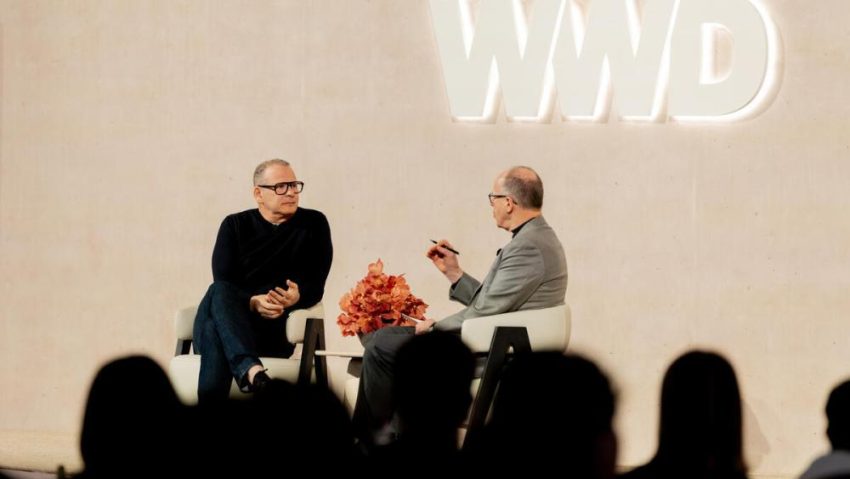
Reed Krakoff has spent much of his career doing jobs that weren’t present before he arrived.
“I’ve never had a job that existed before I had it,” the designer said at the WWD Apparel and Retail CEO Summit, reflecting on a career spanning Coach, Tiffany & Co., John Hardy and, most recently, Gap.
“At Coach, I was the first creative director. Tiffany, I was the first creative director. Gap had never had accessories before in any meaningful way,” he said. John Hardy, meanwhile, was a 50-year-old jewelry house with a distinct aesthetic and untapped potential.
For Krakoff, the work begins by identifying what made a brand successful and determining how that proposition can evolve. “It’s like a puzzle,” he said, involving culture, history, design, imagery and marketing.
His ability to move between mass-market accessories and high jewelry has made him an unusual figure in American fashion. Recent projects include Gap’s handbag launch, John Hardy’s repositioning and work with Proenza Schouler on the revival of its PS1 bag.

Reed Krakoff
Allie Joseph
Despite the vastly different price points, he sees little distinction in the creative challenge. “It’s really the same,” he told James Fallon, chief content officer of WWD and Fairchild Media Group. “They’re all equally difficult and equally doable.” At Tiffany, valuable inventory and a vast retail network complicated change; a smaller company like John Hardy can move faster.
That cross-pollination has become something of a competitive advantage. Krakoff noted that approaches to merchandising, marketing and launching collections that were commonplace in fashion felt decidedly new when applied to fine jewelry.
“It’s a bit of a cheat in a way to kind of bring things from one category to another, and they feel new and fresh,” he said. For Krakoff, moving between disciplines has become as much a source of creative renewal as a business strategy.
Patience matters, too. Krakoff worries that today’s creatives are expected to deliver immediate results without the freedom to experiment. “I think a lot of designers, more and more, don’t get any time,” he said. “If something’s going to be truly thoughtful and surprising, and at the end of the day desirable, it takes some time.”
At Gap, where he is executive director of accessories for Gap Inc., he has translated the retailer’s sportswear codes into handbags. The Five-Pocket Tote, referencing its denim heritage, struck him as an immediate winner
“When we hit on it, I knew it,” he said. “It’s not about the price, but the price is great. It’s not about the brand, but it reflects the brand.”
His product-testing method is simple: put a design on a table and watch for a reaction. “If no one says anything, it’s probably not very good,” he said. “At the end of the day, it’s an emotional thing. It’s about desire. You can’t logic this to death.”

Reed Krakoff and James Fallon
Allie Joseph
That instinct has given his work a life beyond his tenure at individual houses. At Coach, where he spent 16 years, designs from the late 1990s and 2000s have found new currency among younger shoppers. His 18-year-old daughter, who attends Savannah College of Art and Design, recently called to report how many students were carrying vintage Coach bags.
“I think Coach has done an amazing job of reinventing themselves for this next chapter,” he said, crediting the company’s current direction with helping fuel nostalgia for its earlier collections.
His designs for Tiffany, such as the Lock collection, also continue to resonate among consumers. Asked whether it bothers him that designs he did for those brands continue to sell and he isn’t recognized as their creator, Krakoff said not really. “You have to recognize that it isn’t your house any longer,” he said.
But Krakoff doesn’t design according to generational labels. His mother wore the latest fashion into her 80s, while his 22-year-old daughter has traditional tastes. “I’m not a believer in segmenting consumers that way,” he said.
He is equally resistant to separating creative ambition from commercial performance. Recalling being fired by Tommy Hilfiger, with whom he remains friends, Krakoff said the experience taught him that “it’s not about you.” The objective is to create work he believes in that also drives sales, a sensibility he considers distinctly American.
At John Hardy, where he is creative chairman, the task has been to bring a sharper design perspective to a house already grounded in Balinese craftsmanship. “The brand was bigger than the sales when I started,” he said. Its evolution has included a recent jewelry collaboration with Billie Eilish and Finneas.

Reed Krakoff
Allie Joseph
Krakoff sees substantial room to grow. “It’s something that has the potential to be five times the size, even 10 times the size,” he said. He pointed to an opening between independent jewelers and the industry’s largest houses, particularly for jewelry that is recognizable without being overtly branded.
“There’s a huge shift towards things that have inherent value in artisanship, craftsmanship, quality,” he said. The opportunity could extend beyond jewelry into hospitality: “You can see Hardy doing hotels,” he suggested, envisioning a resort or property in St. Barts, describing the possibility rather than announcing a project.
His creative outlook reaches well beyond product. A photographer, ceramicist and art collector, Krakoff recently shot a John Hardy campaign without taking public credit. “I don’t really follow fashion, to be honest,” he said, describing how film, theater and exhibitions help keep his perspective fresh.
His background in economics, art history and design proved unexpectedly suited to the emergence of the modern creative director. “I was preparing for a career that I didn’t know existed,” he said.