If there’s a golden ratio for success in the fashion business, its illustration might resemble a tetrahedron.
During an interview, Sidney Toledano, chairman of the Institut Français de la Mode or IFM, sketched one on a piece of paper, with the words “creativity,” “craftsmanship” and “management” written in each of the three corners, and the word “brand” at the top of the pyramid — the center of gravity and guiding light.
The veteran luxury executive was discussing the IFM’s 40th anniversary, and argued that its teaching across business, design and artisanal know-how makes the Paris fashion school unique — and uniquely powerful.
“There is a process, and I think at IFM we can prepare very well people to speak the same language,” Toledano said, recalling his early days as chief executive officer at Christian Dior, when John Galliano was heating up the French house with his madcap creativity.
At the time, Toledano created a product committee, which was new to everyone “and I used to say to the management, the marketing, the production people: ‘Listen to the vision first … You always need a leader for the creativity.’”

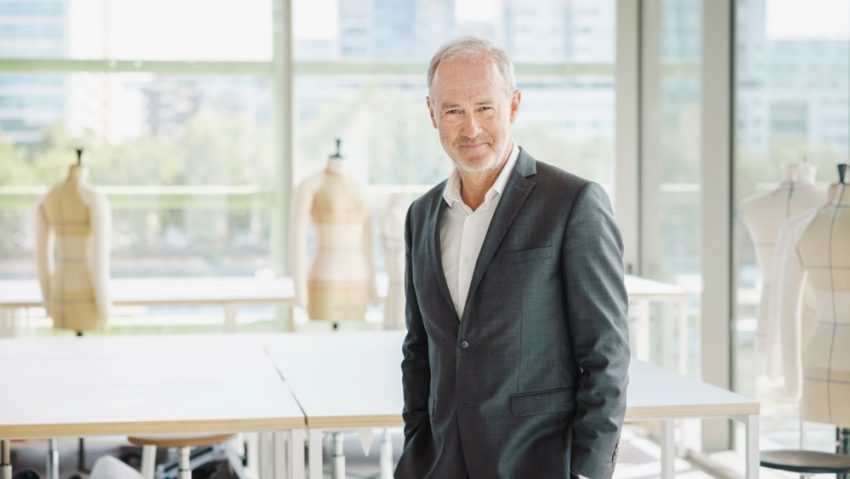
Sidney Toledano
Stephane Feugere/Courtesy of IFM
Xavier Romatet, dean of the IFM since 2019, echoed Toledano’s conviction in the same interview, arguing that having all three disciplines under one roof facilitates dialogue and understanding that is crucial.
“It’s a question of alignment,” Romatet said.
“We give the opportunity for the designers to understand the codes and the language of craft, for the craftspeople to understand the codes and language of the designers, and for the managers to see what is the process and to work together,” he explained. “The IFM brings together students at every level, from vocational training to bachelor’s and master’s degrees and the MBA, across craftsmanship, fashion design, management, and entrepreneurship. This creates a unique environment in which different disciplines, skills, and perspectives coexist and enrich one another.”
The IFM is marking its big milestone with a party in Paris on Wednesday — and from a position of strength. Its flagship program — the master of arts in fashion design — now attracts 350 candidates for every 20 positions in garment design, Romatet said. (On average, six applicants compete for each spot at IFM.)
What’s more, “now that fashion design is at the heart of the school,” the IFM has become more attractive to management and craftsmanship students, according to Romatet.
“People want to work in the fashion industry because of the creative process,” he said. “The fact that (our graduate show) is on the official calendar of Paris Fashion Week, in terms of reputation and activity for the school, is something which is very important … The more we can demonstrate to the market the level of creativity from the students of IFM, the more the school will be recognized as one of the best worldwide.”
Toledano and Romatet stressed that being headquartered in Paris remains one of the school’s most potent calling cards, given the city’s legacy of craftsmanship and savoir-faire — and its concentration of major industry actors, headlined by the luxury groups LVMH Moët Hennessy Louis Vuitton and Kering, plus such megabrands as Chanel, Hermès and L’Oréal.
“You put the same school in Berlin, it wouldn’t work,” Romatet remarked. “What truly sets IFM apart is its deep integration into the fashion industry. Since its founding, the school has maintained exceptionally close, day-to-day relationships with the industry’s leading players.”
CEOs and designers from a wide swath of Paris-based houses regularly give lectures to IFM students at the campus inside the Cité de la Mode et du Design, a striking contemporary building on the banks of the Seine. This year, Celine’s artistic director Michael Rider served as patron of its Bachelor of Arts Graduate Show.
The brands also raise money for scholarships, research and teaching chairs via the IFM Foundation — and also hire many graduates.
“A university cannot ignore the real world. This is why at IFM you will be meeting leaders, management, industry. This is the objective,” Toledano said.
On average, 83 percent of IFM students are employed within one year of finishing their studies, Romatet said.
For those graduating from the École de la Chambre Syndicale de la Couture Parisienne (ECSCP), which was folded into the IFM in 2019 and focuses on fashion and couture craft and technique, the ratio rises to nearly 100 percent.

Looks from the IFM BA fashion show in June 2026.
Guillaume Roujas/Courtesy of IFM
According to the school, some 60 percent of its graduates go on to work for major groups such as Chanel, Hermès, Kering, L’Oréal, LVMH, or Richemont; roughly 20 percent work for smaller companies; 10 percent with service providers for the industry, such as agencies and event production companies, and 5 percent as entrepreneurs or freelancers. Only 5 percent pursue careers outside the fashion and luxury industries.
About 55 percent of the IFM’s 1,400 students now come from outside of France, representing 70 different nationalities. The top-10 nationalities are French, American, Italian, German, Chinese, Swiss, British, South Korean, Spanish and Russian.
For the 2026 school year, there are 620 students in fashion management, the IFM’s original raison d’être, plus 344 in savoir-faire and 436 in design.
The IFM regularly gathers human resources executives from marquee French companies in order to see how hiring is evolving.
“We are able to follow the needs of the industry because of the connection we have with industry leaders at different levels,” said Toledano, who has been chairman of the IFM since 2022 and a board member for nearly 30 years.
Its current board of directors spans senior executives from fashion and couture houses, retail, and the apparel and textile sectors.
Romatet and Toledano touted the consistency and long-term vision of the IFM, founded in 1986 at the impetus of Yves Saint Laurent couture boss Pierre Bergé to bridge fashion design and business management.
“He had the vision and intuition that the industry needed managers better prepared to deal with creativity at that time,” Toledano said.
At that time, only 2 percent of employees in the fashion industry had a higher education background, compared with 14.5 percent across French industry as a whole, according to Romatet.
“What made this initiative remarkable was the willingness of companies to join forces despite being competitors,” Romatet said. “Brands, retailers and manufacturers came together around a shared ambition: to develop the talent and expertise needed to support the industry’s expansion across product categories, international markets and retail.”
Fast-forward to today and the IFM has produced such designers as Nadège Vanhee-Cybulski, who leads Hermès womenswear, Charles de Vilmorin and Rabih Kayrouz, though it is perhaps better known for churning out managers who have filled the ranks of leading luxury groups, beauty companies and retail giants.
Famous alumni of the ECSCP of yore include Karl Lagerfeld, Valentino Garavani, Yves Saint Laurent, André Courrèges and Issey Miyake, though some did not complete their studies.
Among management graduates who went on to become CEOs and senior executives are Catherine Jacquet at Isabel Marant, Myriam Serrano at Alaïa, Sybille Darricarrère at Victoria Beckham, Katalin Berenyi at Clarins, Sandrine Jolly at Maybelline, Berta de Pablos at Pandora, and Polo Raynal at Bureau Betak, to name a few.
“What sets IFM graduates apart, whether they are managers or designers, is their deep understanding of the industry and how it operates, which allows them to hit the ground running from Day One,” Romatet argued.
Meanwhile, the school’s craftsmanship branch has trained the heads of ready-to-wear ateliers at houses including Victoria Beckham, Kenzo and Mugler, as well as many premières mains and premières d’atelier.
Romatet noted the IFM has only had three deans, including himself, in its history. Previously the head of Condé Nast France from 2006 to 2018, Romatet succeeded Dominique Jacomet, who took over in 2007 from Pascal Morand, who is now executive president of the Fédération de la Haute Couture et de la Mode, among organizations that are key allies of the school.
“We manage the school exactly the same way a luxury brand has to be managed: with a long-term, clear vision, consistency of the brand and quality of execution,” Romatet said. “Transmission is a long-term process, exactly like luxury.”
Toledano also trumpeted the importance of looking far beyond quarterly results, hinting that he is working on a project with LVMH chairman and CEO Bernard Arnault, whom he advises, “which may have an impact in 10 years.”
“It’s important to train people to be resilient when you have turbulence,” Toledano said. “This comes with experience, and these are things that we can tell the students … Luxury is a long-term investment. So we have to train our people to make the right decisions.”
The executives also touted how the IFM has evolved with the industry it serves.
“We have had discussions with top-level management to see how the school could be a place for experimentation,” Romatet said. “My mission is to prepare people for the next generation, with the skills they need, and the mindset.”
Two years ago, major luxury players alerted the IFM that product development and manufacturing skills were becoming increasingly difficult to find — even as they strove to increase operational excellence, “particularly in manufacturing processes and in managing relationships with design offices and manufacturers,” he said. “That is why we developed this new specialization within our specialized master’s in fashion management, launched in September 2025.”

Inside the Institut Français de la Mode in Paris.
Mathieu Baumer/Courtesy of IFM
Located within the Cité de la Mode et du Design in eastern Paris since 2008, the IFM has more than quadrupled in size and now takes up about 70 percent of the building’s total space, about 97,000 square feet.
“We have further ambitions to develop new programs and activities, which will require additional space beyond what is currently available to us,” Romatet noted. “We are actively exploring how to accommodate this next phase of growth.”
To strengthen IFM’s attractiveness, Toledando and Romatet described a constant rethinking of its educational formats and content, also integrating new technologies and tools such as artificial intelligence.
“Our role is to ensure that students are equipped to embrace these changes without losing the creative independence and critical thinking that make fashion a unique discipline,” Romatet stressed. “The requirement we have from candidates is their capability to have a creative point of view … It’s not rational. The fashion industry needs passion.”