During business meetings, participants often get distracted, looking at their phone, or even stepping out to take a call.
Not Giorgio Armani.
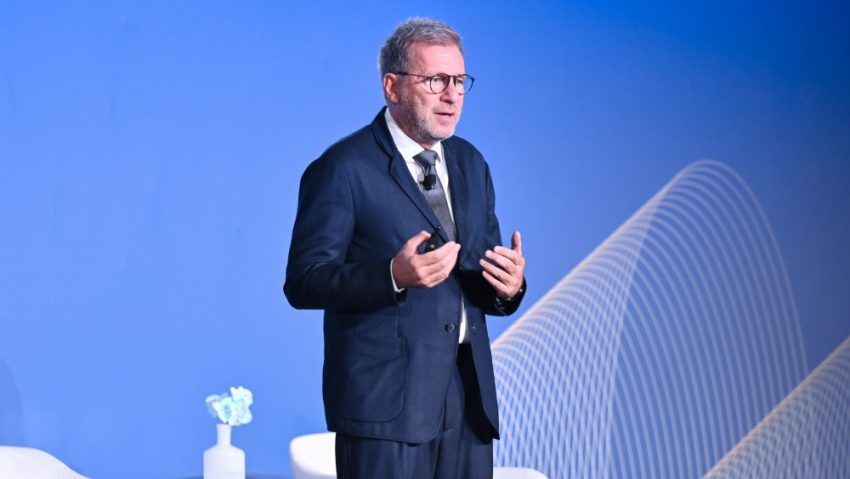
“Quality listening is probably the main lesson I took from him,” Giuseppe Marsocci, the Italian company’s chief executive officer, told the WWD x SKP Global Fashion & Beauty Summit in Wuhan, China. “He was always so focused, so intensely concentrated in his listening approach. This is probably one of the reasons behind his success, in my opinion.”
Tying that anecdote to the host country, he paraphrased Confucius on how wide listening represents a crucial method of learning.
“You will see how many things we have in common with the Chinese culture, and listening is probably the first one,” he told the audience at the invitation-only event, held on Oct. 22 at the Marriott Wuchang.
Marsocci announced at the event that Armani has signed a three-year partnership to support China’s Golden Rooster Awards, which is gearing up for the 37th edition of the film festival and prize, scheduled for mid-November in Xiamen.
Later that evening, the executive also christened a new multistory Giorgio Armani boutique at SKP Wuhan, showing off a red lacquer liquor cabinet decorated with fan motifs.
Later at an art museum tucked into a nature reserve, Marsocci hosted celebrities, influencers and VICs for a lavish, autumnal dinner spanning pumpkin soup and truffle-infused steak.
In his keynote address in the hotel’s main ballroom, Marsocci stressed that the founding designer, who died last year at age 91, left a detailed roadmap for the company, including a clear design language, hinged on minimalism, tinged with Oriental elements and spanning a complete lifestyle.
“Armani is not anymore only products and collections. It’s really a way of living. Our business model is not a group of brands; it’s a group of experiences under the Armani umbrella,” he said, cueing up a sizzler video flashing images of runway shows, store ribbon-cuttings, global events, hotels, branded residences, restaurants, furniture and even chocolates.
Marsocci acknowledged industry-wide questioning about the future of the brand without its famous, charismatic and exacting founder.
“First of all, we have something that is giving us a lot of confidence. Mr. Armani was not about only business. That would have been more difficult to give continuity. Mr. Armani, as we said, is about values, even personal values, even about life,” the bespectacled executive said. “We think that helping and supporting the continuation of certain values is an easier way to continue his legacy. Because if it was only about him, it would be quite difficult to continue.”
He highlighted the creation of the Giorgio Armani Foundation, which will always hold at least 30 percent of the company’s shares — no matter who might take an important stake in future — and be able to give some direction. In his will, Armani detailed nine founding principles for future brand stewards to safeguard, while defending the brand’s aesthetic identity and values.
But Marsocci also stressed that the company is evolving, elaborating on the recent appointment of Dario Vitale as the creative director of Emporio Armani and Giorgio Armani Accessories.
“This is a very important change because it’s the first time ever that someone not part of the Armani family has been involved in the creative direction,” he told the audience. “Managing creative directors is like managing the superstars in the sport industry: very difficult to manage, but very crucial for the business.”
He noted that Vitale, who catapulted to fashion fame for his one-season stint designing Versace after a long career behind the scenes at Miu Miu, would work “under the umbrella of” Leo Dell’Orco and Silvana Armani, who worked beside the founder for decades on menswear and womenswear respectively. “They represent the DNA of the company, so that’s why it’s important: A new creative direction, but within the support and the path indicated by the brand and the people that have represented the brand forever.
“Preserving the consistency doesn’t mean standing still,” he added.
The company’s conviction is that “slow is solid. It means long-term growth and healthy growth,” Marsocci said. “This is really representing our way, and that starts from his design approach. And here again, you will notice something in common with the Chinese culture — not taking things to the extremes, the absence of excess. That means essentiality, harmony, balance.”
The executive, who has logged nearly 25 years within the Armani Group, recounted the Italian brand’s history in China.
Armani opened his first boutique in 1998 in the Peninsula Palace Hotel in Beijing. “He was a real pioneer,” Marsocci remarked, also recounting when the designer visited The Forbidden City in 2004, having often looked East for inspiration.
Armani hosted one of his big One Night Only events in Beijing in 2012 and paraded 15 Armani Privé couture dresses as a tribute to China. In 2015, he dedicated his spring Armani Privé collection to bamboo, myriad prints, embroideries and appliqués depicting its stems and leaves.
“It’s a humble material, but it’s very resilient,” Marsocci said, lauding the “sophisticated elegance” it telegraphs when referenced in Armani Casa collections, and in Armani store concepts.
The executive also trumpeted the company’s legitimacy in all things cinema.
Well known for dressing Richard Gere in the 1980 film “American Gigolo,” which catapulted the stature of Armani and his soft tailoring, the Italian designer costumed Tony Leung Chiu-wai and Takeshi Kaneshiro in the 2006 Chinese movie “Confessions of Pain.” He went on to collaborate with Chinese director Jiang
Wen on “Gone with the Bullets” in 2014 and “Hidden Man” in 2018.
“Many luxury brands connect with the film industry, but we started 30 years ago,” Marsocci said, flashing a slide showing George Clooney, Jonathan Bailey, Kendall Jenner and Italian singer Levante wearing Armani at the most recent Venice Film Festival, of which Armani is a major patron. “Our connection is really part of the DNA of the brand….Our connection with the film industry is very strong.”
He made a plug for the autobiography Armani wrote in 2022, “Per Amore,” which is now available in the Chinese language, giving readers an in-depth look at his life, values and character.
“He wrote that cinema was his real education,” Marsocci related. “He always used to say that if he was not a designer, he would have been a director.”