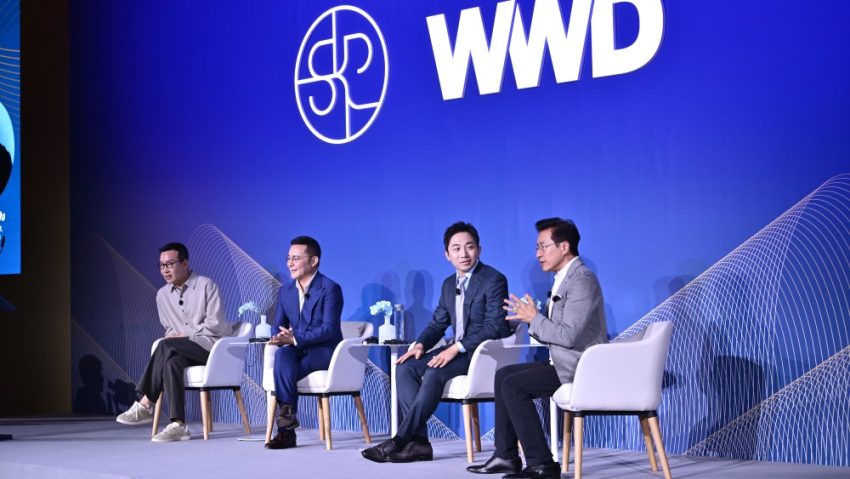
WUHAN — At the WWD x SKP Global Fashion & Beauty Summit, three generations of Chinese entrepreneurs shared how they offer emotion, culture and lasting value for fashion consumers in today’s China.
For Wang Ning, the man behind the global success of Labubu and Pop Mart, the takeaway was about how a small interest can grow into something much bigger.
The founder of the fast-expanding collectibles company described a path that began in the world of trends and expanded into fashion and, ultimately, a broader promise: the pursuit of beauty and happiness.
The ambition, he said, is to create something that speaks to a simple human desire: one that can resonate beyond a particular category or market.
“Everyone wants beauty and happiness. Even when people grow up and face pressure and difficulties, inside they still want something simple and pure. They want companionship, and they want to feel comforted,” Wang said.
That idea is expressed in the company’s characters and symbols, including its small-crowned mascot, hailing from Molly, the first artist IP Wang signed with Hong Kong artist Kenny Wong in 2016.
Wang said Pop Mart’s task today is not only to sell a collectible but to preserve a sense of playfulness that people can carry into adult life. It is a different kind of fashion proposition. It’s less about dressing for a moment than about creating a world people want to enter.
Moderated by LVMH’s Greater China president Andrew Wu, who joined Pop Mart last year as a non-executive director, the discussion also touched on how China’s consumer market has changed.
Shoppers, Wu observed, are no longer satisfied with a brand simply being new, foreign or inexpensive. They want to know what it stands for and whether it offers an experience or feeling that matters to them.
That shift has helped reshape the opportunity for homegrown brands, including Mao Geping’s namesake beauty company.
A legendary figure in China, Mao’s career began as a makeup artist and teacher. He then saw a gap in the market: Chinese women were interested in makeup, but the dominant standards and products largely came from Western brands.
“I felt that Eastern beauty needed its own way of thinking. It should not be about making everyone look the same. It should help each Chinese woman discover what is distinctive about her own face and bring that out,” he said.
Mao began by establishing a makeup school and developing products that could support the techniques he taught. The company’s model has continued to link beauty products with education and professional service. Mao said its schools have trained makeup artists who can bring the brand’s approach directly to customers.
The brand’s development also reflects a wider rise in cultural confidence.
In 2018, Mao began working with the Palace Museum, drawing on traditional Chinese imagery and motifs for annual collections. The collaboration gave the brand a way to connect its products with a cultural history that consumers were increasingly eager to explore.
Still, Mao said, cultural references alone are not enough to build a lasting business. A brand needs a recognizable point of view and products that can stand on their own.
“Having your own characteristics is very important. You have to understand young people, but you also have to understand your own style. If you simply follow whatever is popular at the moment, you have no future. The classic and the new have to meet, and each has to learn from the other,” he added.
For Ma Yin, founder and chief executive officer of Aranya, the starting point was a very different kind of business: real estate. Meaning “forest” or “wilderness” in Sanskrit, Aranya is a pioneer of cultural and tourism real estate projects in China.
He entered the property sector with a conventional development mindset, but a project that could not be sold as planned forced him to reconsider what a residential development could be.
Looking back, Ma said, the setback became an early chance to change course. Instead of focusing only on buildings and their functions, he began thinking about what a place could offer emotionally and socially.
“Traditional development is often about building more, or making the house more expensive. But a home should offer something beyond the physical. It should meet people’s emotional needs and their need for a sense of meaning,” he said.
That idea helped shape Aranya, a coastal community in Qinhuangdao, two hours by train from Beijing, growing into a lifestyle destination, with cultural programming and shared spaces at its center.
For Ma, the project is also a response to the isolation of modern city life. People may live close to one another, he said, yet remain strangers to their neighbors.
“We have become very independent, very rational, and at the same time very lonely. If you can create a place where people connect, where they get to know one another and become familiar, you can begin to rebuild that sense of community,” he said.
Aranya’s cultural events are part of that effort, most notably hosting the Louis Vuitton men’s spring 2023 spin-off fashion show during the COVID-19 pandemic.
Ma said the value of getting people away from the routines and noise of the city is so that art, music and theater can be experienced differently. The aim is not simply to build a resort or sell homes, but to create a setting where people can feel part of something.
The four also repeatedly touched on the idea that China’s fashion and lifestyle market is maturing. Consumers are more exposed to global brands and increasingly discerning about what they buy. That does not mean they are rejecting international products. Rather, they are choosing according to their own tastes, values and sense of identity.
Summing up the panel, Wu said the qualities that help businesses endure in China include a clear understanding of product, the ability to create experiences around it and the persistence to keep building through difficult periods.
The opportunity, he added, is not just to make something Chinese, or something fashionable, but to make something distinctive enough to matter to Chinese at home and abroad.