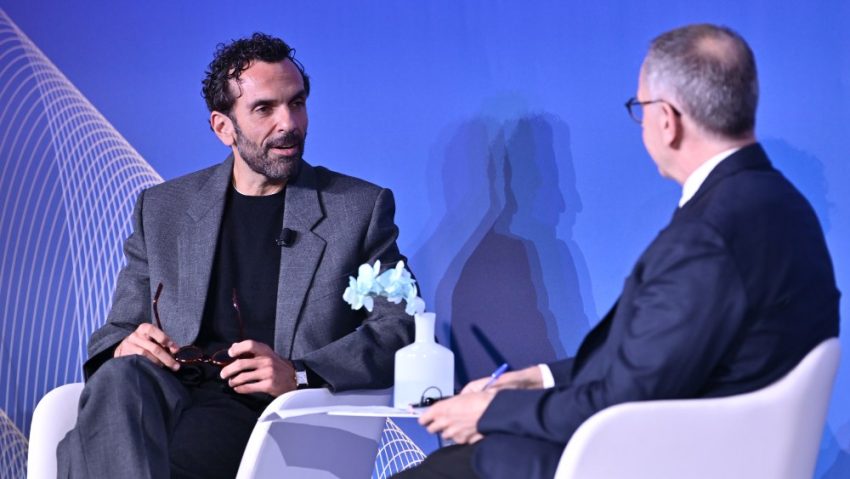
WUHAN — “Yves Saint Laurent was never looking backward,” Cédric Charbit, chief executive officer of Saint Laurent, said at the WWD x SKP Global Fashion & Beauty Summit in Wuhan, China, on Oct. 22. “He was always in sync with his time and always looking at what was happening next.”
Charbit said that idea is as relevant to the house today as it was to its founder: use Saint Laurent’s history to engage with the present, rather than preserve the past.
On stage, the CEO since January 2025 thanked Anthony Vaccarello for his decade as creative director. Vaccarello stepped down earlier this month and a successor is expected to be named soon.
Charbit said Vaccarello had made “a massive impact on our financial trajectory, on our image” and created “a very recognizable silhouette” for men and women. He also credited him with helping the brand build cultural relevance.
“Ten years in our industry is quite a long one,” Charbit said. But a CEO, he added, has ”to look at the future and plan ahead the next 10 years.”
Saint Laurent is in a strong position, he said, but “there is somehow much more we can do with it.”
For Charbit, that forward-looking spirit goes back to Yves Saint Laurent himself.
The designer arrived in Paris at 19 and opened his couture house with Pierre Bergé at 21. “He had no heritage in mind. He didn’t know he would leave behind him such a great legacy,” Charbit said. What mattered then was expressing “his creativity and vision.”
The house’s move into ready-to-wear in 1966 was another example of Saint Laurent responding to his time. The shift reflected a changing society, Charbit said, as women increasingly bought clothes with their own money. Ready-to-wear was “about understanding the now.”
So how does a fashion house work with its heritage without getting stuck in it? Saint Laurent has extraordinary archives, codes and savoir-faire, Charbit said. But the real question is: “What do you do with all this?”
For him, the answer starts with having something meaningful to say.
“You need to be authentic. You need to be credible. You need to tell a story that allows people to live,” he said. Without a background, skills and rules, he added, “there is nothing you can tell your clients.”
That clarity matters even more in a difficult luxury market.
“You have no choice” but to learn to operate through highs and lows, Charbit said. When business is booming, confidence can turn into overconfidence and investment into overinvestment. When the market slows, companies can become too cautious and start questioning everything.
“What you need to do is to really clarify what you stand for, what you believe in as a company, as a brand,” he said. Challenging conditions shouldn’t curb ambition, he added. “It should simply make it more precise and sharper.”
Charbit said Saint Laurent’s recent product launches and experiences had performed well; his focus is on “what to do next and how to do things better.”
When asked about the house’s priorities for the future, Charbit put creativity first.
“No compromise about this. Creativity is at the center of Saint Laurent,” he said. While one person may have the vision, he added, bringing it to life is “a collective achievement,” involving everyone from merchandising and retail to the supply chain and the atelier.
Saint Laurent also wants to become a more complete house, Charbit said, but “never at the expense of identity.” That means looking across categories, geographies, clients and experiences, and finding ways to serve them better.
The client, he added, needs to stay at the center of those decisions.
Charbit said he pays attention to every touchpoint, from stores to online and offline activities. Experiences, he said, will only become more important.
In an industry that tracks everything from traffic and sales to fashion-show performance, Charbit said he’s also interested in what a spreadsheet can’t capture: a brand’s ability to create desire and offer experiences that matter. “You cannot really build that desire in the long run from a spreadsheet,” he said.
Technology, including artificial intelligence, can help brands understand their clients and anticipate what they might want, he said.
But fashion houses shouldn’t stop at giving people what they already expect. “We need to do things that people don’t have the idea they will want to wear in the future,” Charbit said. “We need to surprise them.”
He sees luxury becoming more personal, too.
Charbit questioned whether clients still buy things to impress people they don’t know, or to post a picture and seek likes. Increasingly, he said, clients want to express themselves, feel inspired and be part of a community.
Charbit said his own approach to leadership was shaped by years in retail and by working with creative teams. He recalled a conversation with SKP chairman Ji Xiao’an about store layouts, assortments and brand positioning, and said the exchange offered a valuable Chinese perspective on retail.
Working with creative leaders also taught him the importance of believing in a vision and bringing others along. The best work, he said, comes from bringing together different expertise, opinions and even disagreements. “It’s never a one-man show.”
Over time, Charbit said, he has come to value action as much as the outcome. “What matters the most is the action itself,” he said. Take the risk, learn from the decision and move forward — whether it leads to success or a mistake.
Saint Laurent’s connection with China goes back decades. Charbit cited the house’s 1977 Chinese collection and Yves Saint Laurent’s 1985 visit to Beijing, where he was invited by China’s culture minister and held a retrospective at the National Fine Arts Museum.
“I am very confident in the future we have here in China,” Charbit said, while acknowledging that Saint Laurent still has work to do.
The brand entered the market in 2010, he said, and is relocating, renovating or redesigning stores, rethinking assortments and working to communicate more effectively with local clients. He said the goal is to address 90 percent of the store network by the end of 2027.
Charbit said the aim isn’t growth for its own sake. “We want to make sure we matter more,” he added.